Black Myth: Zhong Kui's Combat, Explained — Sword, Talismans, Deflects and the Possessed Ally

The 15-minute Black Myth: Zhong Kui demo spends most of its runtime on combat, and most of the English-language coverage so far has stopped at "it looks like Wukong with a sword." It is not. We went through the footage exchange by exchange — the sword strings, the resource loop, the deflection system, the talisman skills and the strange black-cloaked ally — and checked the technical claims behind them. Here is the combat system as it actually appears, with what is confirmed, what is observed, and what is still guesswork.
Research boundary. The footage is a work-in-progress test build. Mechanics below are described from what is visible on screen; move names are our provisional English renderings, not official ones. Where a claim comes from community analysis rather than the footage, we say so.
What we found
- The sword combat runs on a "build then cash out" loop: basic strings build a resource, and skills spend it.
- Deflection is a standing mechanic — but it is not a perfect-guard system. The real "perfect" defense appears to live somewhere else entirely.
- Paper talismans are combat skills with elemental behaviors: fire that spreads through vegetation, lightning that enchants the blade, and a summonable ally.
- The black-cloaked ally is a two-mode system: a summon you can also possess — and the possessed state changes the rules.
- Executions and deflects adapt to enemy body size, including enemies parrying the player.
- The engine is officially Unreal Engine 5; more specific version attributions are marked where they could not be verified.
The sword: four-hit strings with combo branches
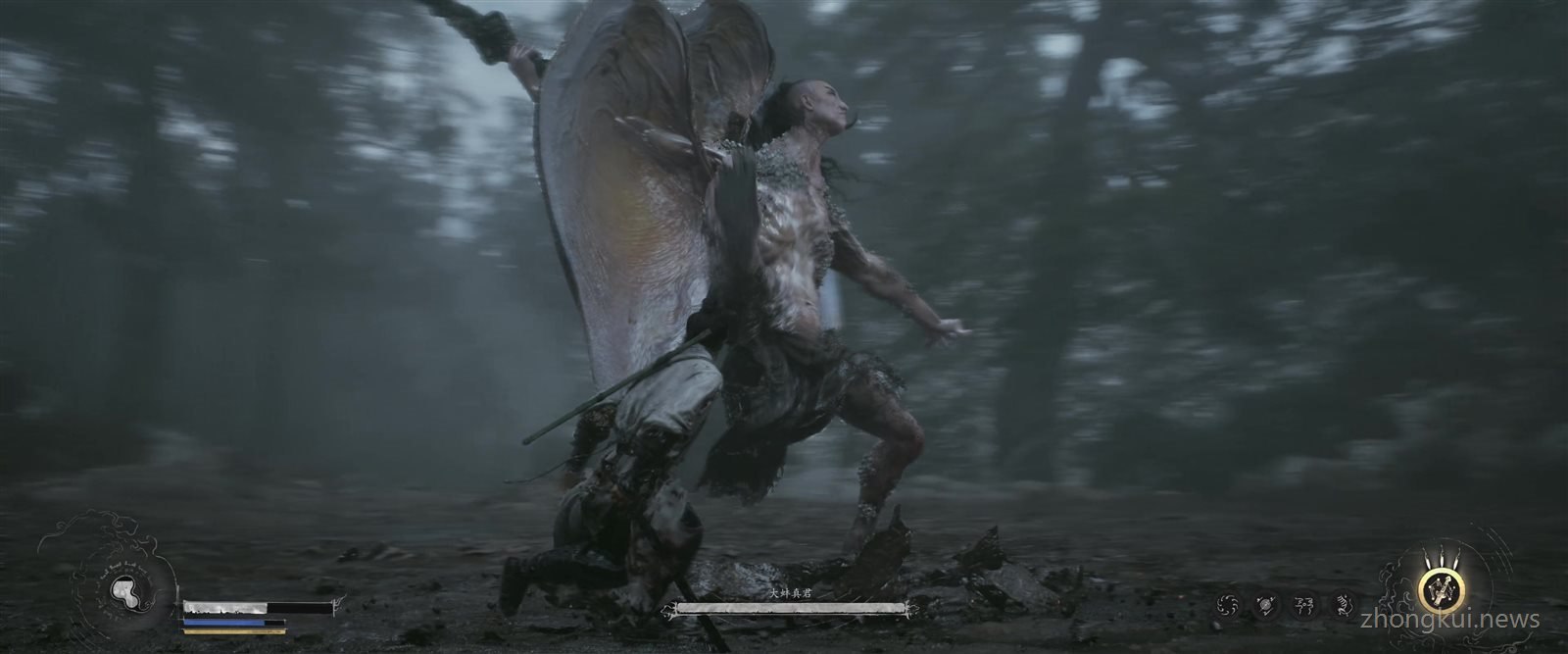
The demo's bread-and-butter is a straight sword used in tight, close exchanges — a deliberate contrast with Wukong's space-making staff. The base string is a four-hit sequence: a diagonal slash into a rising back-cut, a spinning horizontal sweep, and a downward finisher. Around that base the swordsman branches into alternates: point-thrusts, a tai chi-style redirect into a lateral cut, and combo extensions that chain straight into executions without a break in animation.
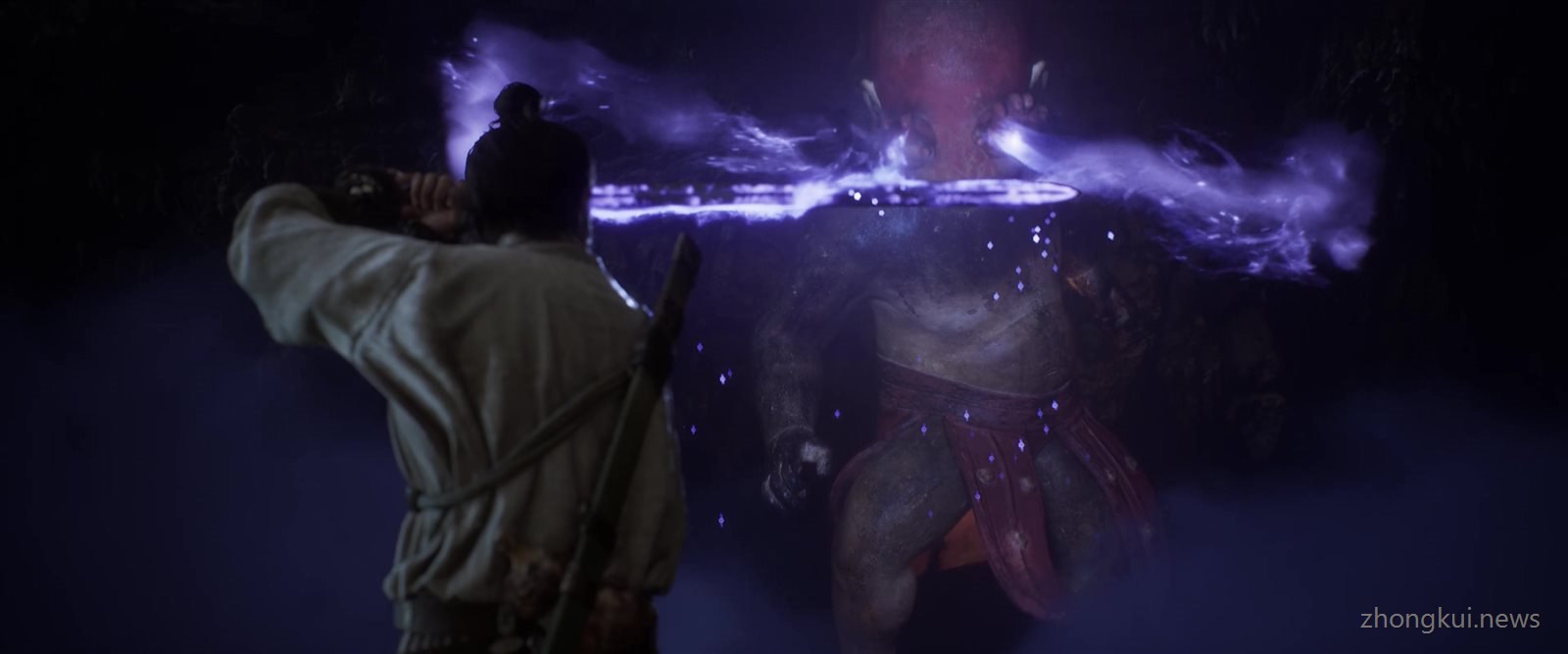
Executions adapt to the target's body size — the finisher against a human-sized ghost is not the animation used on the giant clam boss. Combat details persist between phases: bloodstains on the swordsman's robe remain visible in the cutscene that follows the fight, and mid-combat he idly straightens his scabbard. These are small things, but they tell you the animation set is systemic, not canned. Observed
The resource loop: build, then cash out
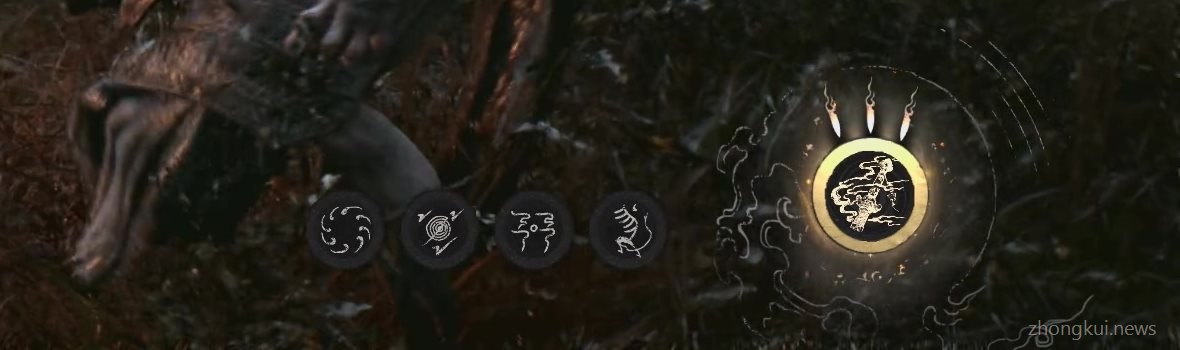
The lower-left HUD carries health, spirit and stamina bars; another meter builds as the swordsman lands attacks and deflects. The rhythm will be familiar to Wukong players, but the emphasis shifts: where Wukong rewarded spacing and transformation windows, this demo pushes the player to stay in contact, build, and spend. You do not turtle behind a guard — you keep trading. Observed
Deflection is not perfect guard
This is the demo's most misread mechanic, and the one that matters most to get right.
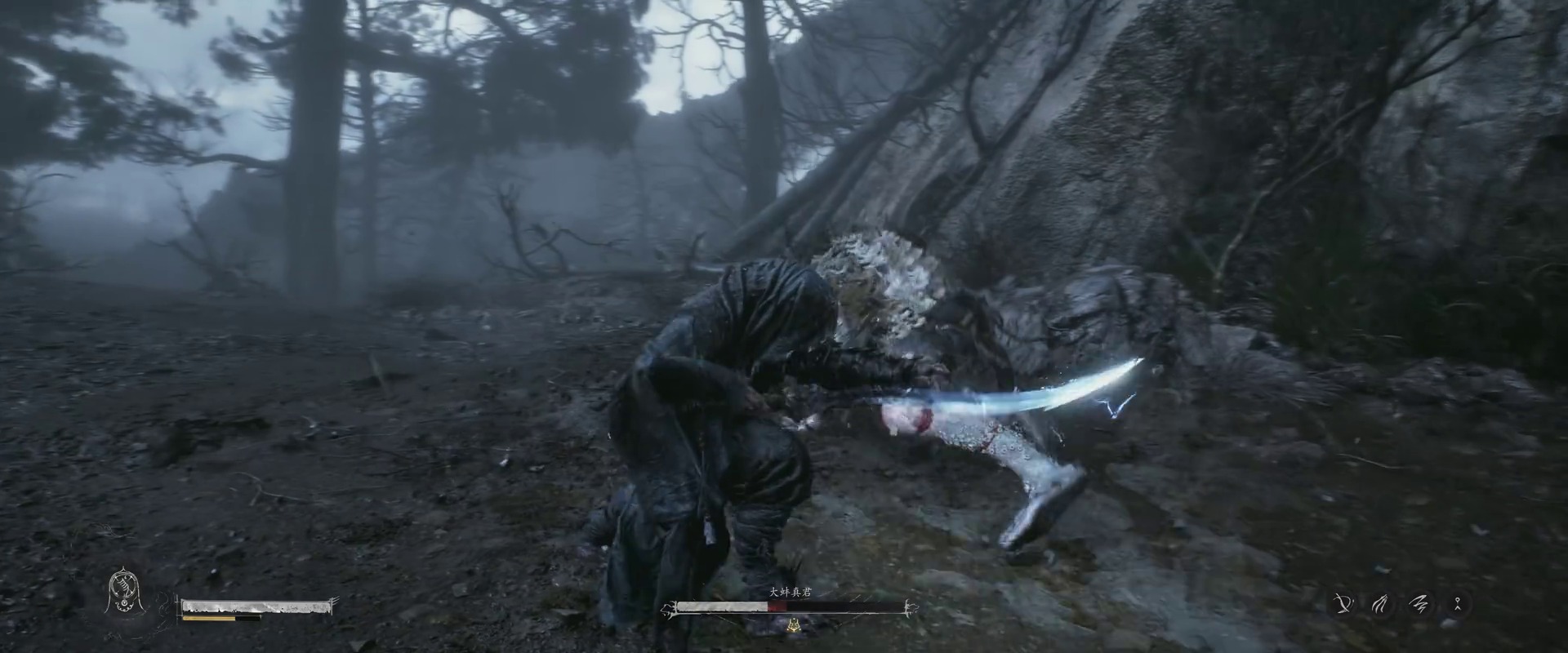
The swordsman has a standing deflect: the jiaojian (绞剑, "coiling sword") family of moves where the blade sticks to the enemy's weapon in a small circle and wrenches it aside, plus plain block-deflects that send the boss's swings visibly off-line. It looks like a Sekiro-style perfect guard. It is not one, for three reasons visible in the footage:
- Deflect has real recovery. The swordsman's post-deflect animation is long enough to be punished — it is a commitment, not a free reset.
- It grants no punish window. A successful deflect does not stagger ordinary enemies or open them up the way a perfect parry would; it buys you survival, not a free hit.
- Enemies can do it back. The elite greatblade ghost deflects the player's attacks in the same fight, which tells you deflection is a shared combat language, not a player privilege.
So where is the "perfect" defense? Watch the black-cloaked ally. When the swordsman possesses it (more on that below), the ally's blocks produce slow-motion windows and visibly larger staggers — the properties players expect from a true perfect guard. The reading this suggests: the designers split defense into two tracks. The swordsman's body trades and survives; the ally is where the highlight-reel defense lives. Analysis
For a useful contrast, look at Capcom's Onimusha: Way of the Sword (September 4, 2026), which revives the Issen — a timing-based counter that converts a well-read defense into a killing blow (Capcom; demo report). The Issen is exactly the "defend, then get paid" mechanic that Zhong Kui's deflect pointedly refuses to be for the swordsman. Two games, two answers to the same design question. Analysis
Deflects have a counterpoint: the See Through dodge
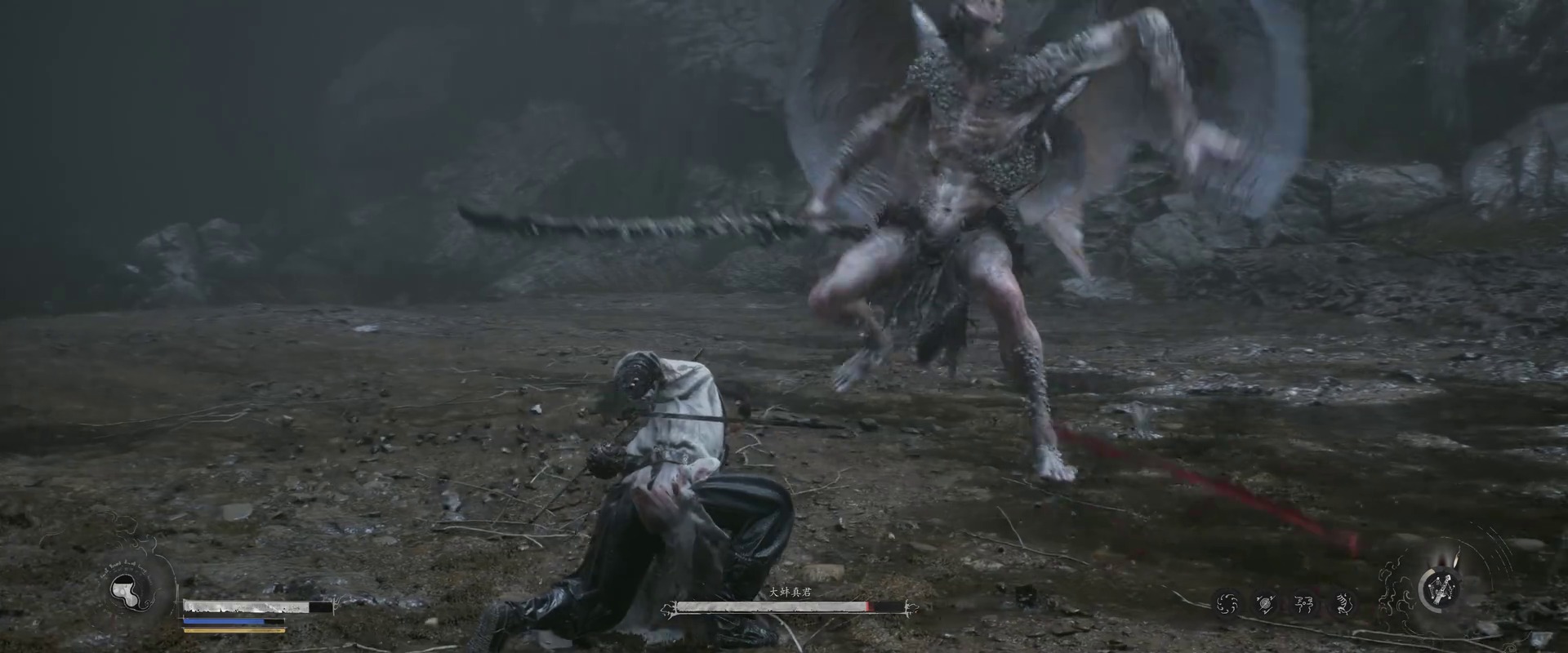
Separately from weapon deflection, the swordsman has a dodge with its own timing layer — a See Through (看破) window, named after the same mechanic in Black Myth: Wukong's official English localization, where a well-timed evade produces a distinct flash and a counter opportunity. Against the clam boss, you can see it trigger right as its overhead slam lands. The two systems reward different skills: deflecting rewards holding your ground and reading weapon lines; the dodge rewards reading the attack itself. Observed
Talismans are combat skills, with behaviors
The paper talismans are not generic spells — each one we've seen has a physical behavior attached:
- Fire (the fire-wheel skill). Sends a wave of flame across the ground — and the fire keeps spreading through nearby trees after the cast, visibly intensifying over several seconds. The environment participates.
- Lightning (the thunder enchant). A talisman pressed to the blade charges it with arcing electricity that persists through the following combo — classic thunder-talisman-on-sword Daoism, and it transfers to the ally (below).
- Summon (the black-cloaked ally). Calls a second combatant that fights its own engagements rather than playing a canned attack.
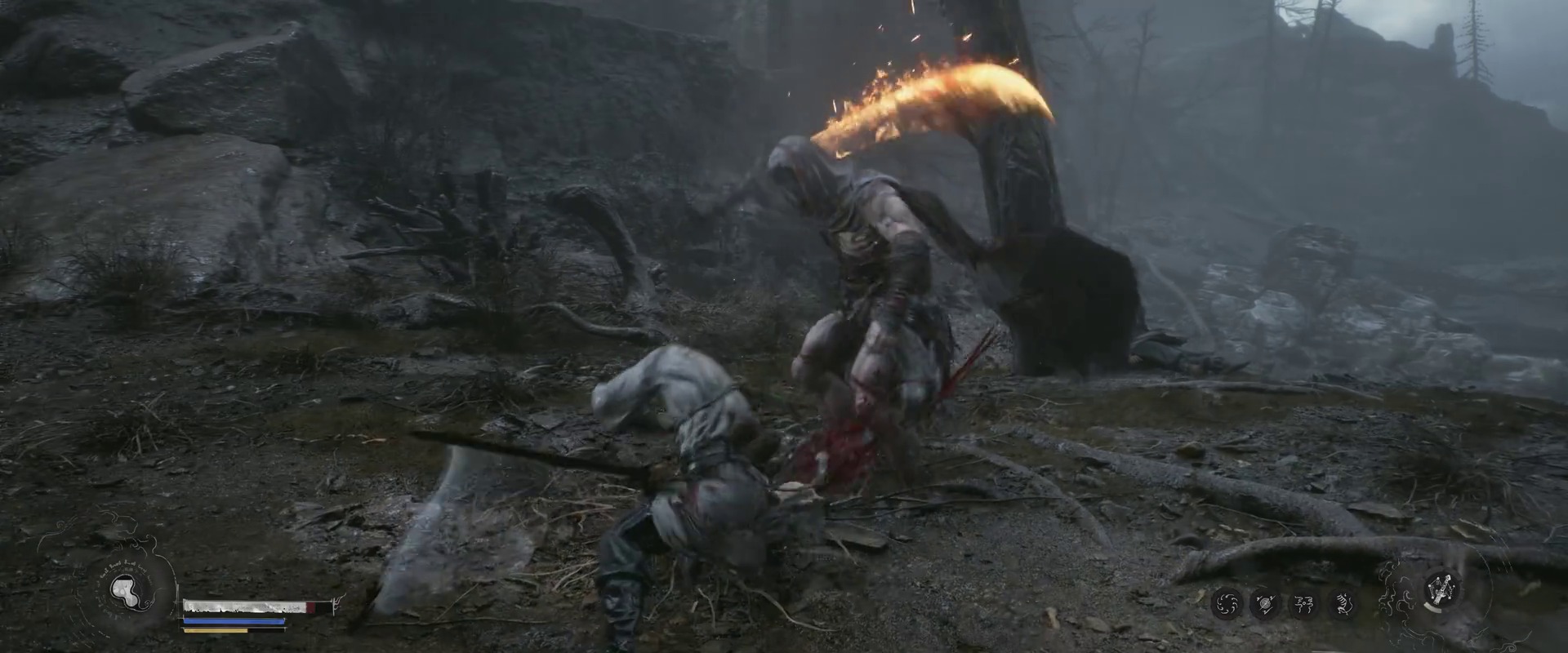
The fourth icon row sits beside a gauge we have not seen filled, so the full skill list is longer than what the demo shows. What is here already frames talismans as the game's spellcasting identity: written commands, cast through the sword. Observed
The black-cloaked ally: a summon you can step inside
The demo's most unusual system shows up in the boss fight's second half. The ally is called in as a summon — a black-clad fighter who trades blows with the boss, intercepts its swings and even parries for the team. Then the rules change: the swordsman's own body vanishes from the field, and the ally fights on with an altered moveset — aerial spinning slashes, the slow-motion defensive windows, heavier staggers. The lightning enchant active on the swordsman's blade carries over onto the ally's weapon.
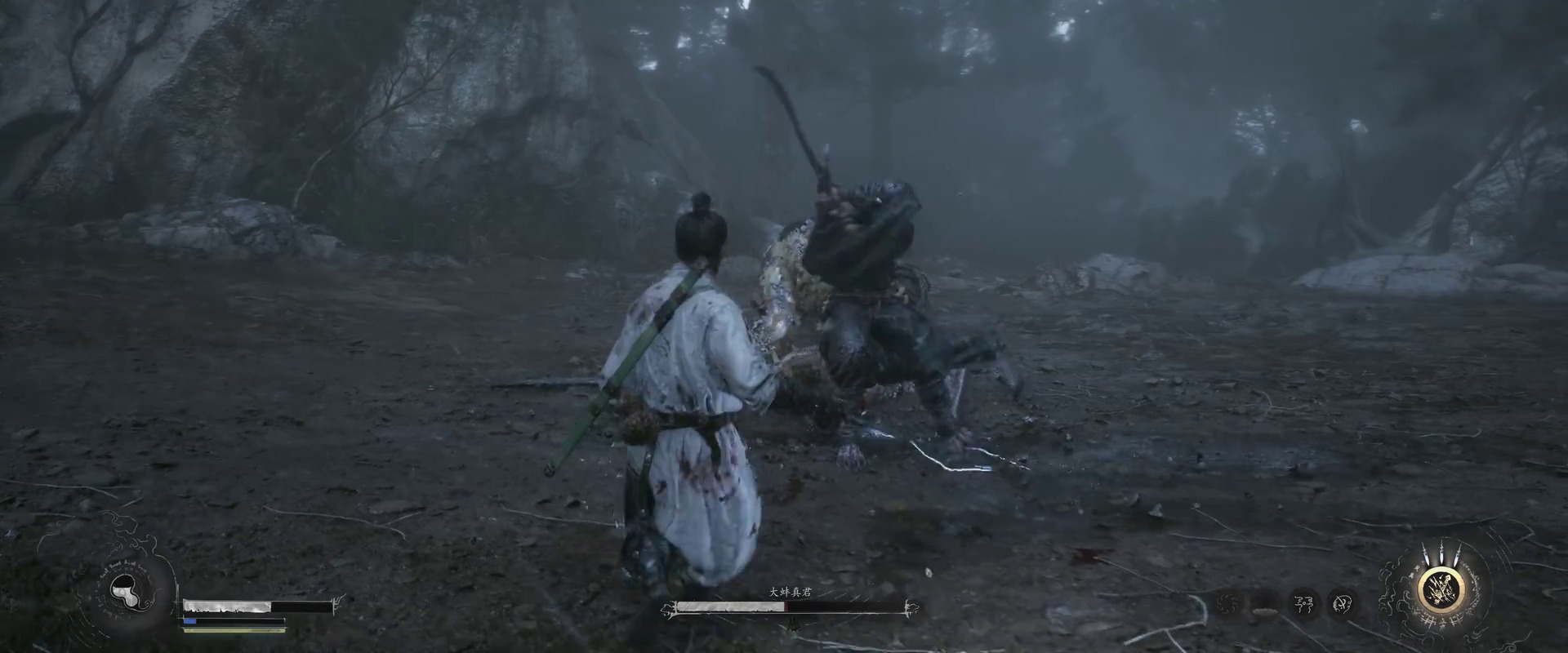
Read one way, it is a summon with a stance change. Read another, it is a possession mechanic — the player steps out of their own body and into a stronger one. The demo does not explain which, and the difference matters for everything from build diversity to story (our protagonist analysis follows that thread). What the footage supports plainly: this is a two-mode ally with its own defensive tier, and enchantments transfer into it. Analysis
Enemies play by the same rules
Two small observations that say a lot about the design's floor. The elite greatblade ghost — the one that survives long enough to appear in the post-fight cutscene — deflects the player's attacks using the same wrench-aside technique the player has. And the giant clam boss visibly changes behavior when its shell breaks: it discards the other half itself and speeds up, trading armor for mobility. Systems over set-pieces, again. Observed
The technology corner
The game is built on Unreal Engine 5, widely reported since the demo and consistent with everything on screen (WccfTech's UE5 assessment, Chinese mirror). Two of the community's more specific attributions check out with caveats. The vegetation is plausibly Epic's Nanite Foliage — the same technology Epic previewed in The Witcher 4 tech demo (which ran on UE 5.6) and later shipped as an Experimental feature in UE 5.7 (Epic; Game Developer) — an Experimental tag is worth keeping in mind before treating it as the finished article. The cloth work matches Epic's Chaos Cloth, which was still in beta in UE 5.7 and only declared production-ready in UE 5.8 this June (release notes). One officially confirmed production detail did surface separately: the old man's face is performed by veteran actor Li Guangfu via facial capture (Yangcheng Evening News). Claims that the facial pipeline follows a MetaHuman workflow, and that the water is a custom in-house solution, are community speculation with no official source — plausible, and unproven. Analysis
What we still don't know
- The official names of any of these mechanics; all English move names here are provisional.
- The exact rules of the resource meter and what fills the fourth skill slot.
- Whether possession is a combat stance, a story mechanic, or both.
- Whether deflect frames scale with investment (gear, skills, upgrades).
- Any platform, performance or release information.
The takeaway
One demo boss fight is not a combat system, but the pattern is already legible: a sword that wants contact, a defense split between a survival tool and a spectacle tool, spellcasting written on paper, and enemies that speak the same mechanical language as the player. If Wukong's combat was about the journey west, this one is being built around the work of a ghost-catcher. We will update when Game Science says more.
Related: the scene-by-scene demo read, the creature research reference, the protagonist analysis, and the latest official updates.
A note to readers
Unless otherwise noted, the frame analysis, mechanic readings and English move names are by ZhongKui News. If you cite this research: ZhongKui News, "Black Myth: Zhong Kui's Combat, Explained," August 22, 2026. Corrections and research questions are welcome via our contact page.
Update log. Published August 22, 2026. Mechanics described from official footage; engine attributions beyond UE5 are labeled as unverified community analysis. Frames are from the official gameplay video.
Sources
Official material
- Official gameplay video. Black Myth on YouTube, August 20, 2026. All timestamps and frames; also official Bilibili upload.
- Official Black Myth: Zhong Kui page. Game Science.
- Unreal Engine 5.7 announcement (Nanite Foliage, Experimental) and UE 5.8 release notes (Chaos Cloth production-ready). Epic Games.
- Onimusha: Way of the Sword. Capcom, September 4, 2026.
Reporting and analysis
- WccfTech's UE5 assessment (Chinese mirror). Engine attribution.
- Game Developer: The Witcher 4 tech demo. Nanite Foliage previewed on UE 5.6, slated for 5.7.
- GamingBolt: Onimusha gamescom demo and All Things How: Issen mechanics. The Issen comparison.
- Yangcheng Evening News. Li Guangfu's facial capture for the old man.


