A Thousand Years of Zhong Kui: From Exorcism Tool to Game Hero

The hero of Black Myth: Zhong Kui did not arrive in 2026. He has been arriving for a thousand years — as a ritual club, a failed examinee's ghost, a painter's political allegory, a door god, a minor entry in a gods' registry, and finally a video game protagonist. Most English coverage of the new game retells the legend. This page does something different: it traces how the image of Zhong Kui was built, layer by layer, through the primary sources — and corrects a few things the internet keeps getting wrong about him.
Research boundary. Historical claims below cite primary texts; readings of what Game Science is doing with them are marked as analysis. The word "hypothesis" appears exactly where the scholarship stops being certain. Our lore guide covers the legend itself; this page is about the image's evolution.
What we found
- The name "Zhong Kui" may descend from an actual exorcism weapon — a fact established in Han-dynasty ritual texts, though the name-etymology itself is a Ming-Qing scholarly hypothesis.
- The famous dream-of-Emperor-Xuanzong story is regularly misquoted: Shen Kuo never named the book it came from.
- Zhong Kui was painted as an imperial gift in the Tang, and was still a separate figure from the door gods in the Northern Song — their merger came much later.
- The political reading of Gong Kai's famous handscroll is a live scholarly debate, not a settled fact — and the scroll itself cannot be freely reproduced.
- The viral list of Zhong Kui's "five ghost attendants" has no pre-modern source. The real five-ghost story is stranger and older.
The evolution at a glance
| Layer | What Zhong Kui was | Anchor text | Confidence |
|---|---|---|---|
| Han–Six Dynasties | Zhongkui the exorcism club (终葵) | Kaogong ji + Zheng Xuan's note; Shuowen | Established text |
| Tang | The dream ghost who failed the exams; an imperial gift painting | Mengxi Bitan, Bubit'an juan 3; gift-painting memorials | Established text |
| Song–Yuan | The painter's brooding exile; New Year prints | Gong Kai's scroll; Dongjing Menghua Lu | Text; readings debated |
| Ming–Qing | Door god; gods'-registry entry; stage demon-queller with five ghosts | Sanjiao Yuanliu Soushen Daquan; Yuan-Ming zaju plays | Established text |
| Name origin | "Zhong Kui" from "zhongkui" the club | Rizhi Lu juan 32; Gaiyu Congkao juan 35 | Hypothesis |
The name: an exorcism tool first
Long before he was a person, zhongkui (终葵) was a thing — a big ceremonial club for driving off evil. The Kaogong ji (考工记) describes a jade scepter "with a zhongkui-shaped top," and Zheng Xuan's Han-era commentary explains it in two characters: "终葵,椎也" — "zhongkui means club" (Shuowen Jiezi Zhu, via CTP). The Shuowen Jiezi adds that in the state of Qi, that is simply what people called it.
So how did a club become a god's name? The credit for that theory goes to Ming scholars, centuries later. Gu Yanwu examined it in the Rizhi Lu (juan 32): "the ancients used clubs to expel ghosts, much like the Nuo exorcism" (Han Dian mirror). Zhao Yi then argued the case at length in the Gaiyu Congkao (juan 35). It is the standard etymology you will read everywhere — and it is, properly, a hypothesis: a compelling philological guess, not a documented lineage. Analysis
The Tang: a ghost with a grievance, and a gift
The oldest datable Zhong Kui story is also the one most often misquoted. Shen Kuo's Mengxi Bitan (Bubit'an, juan 3) records a "Tang-dynasty inscription" with the tale: Emperor Xuanzong dreams of a great ghost devouring lesser ghosts. The ghost introduces himself — "臣钟馗氏,即武举不捷之土也" — "your servant Zhong Kui, one who failed the military examination" (CTP; some editions read 士 for 土).
Here is the correction worth making: Shen Kuo never names the book. The claim that the dream comes from the lost Tang collection Tang Yishi (《唐逸史》) is a later attribution — it appears in the Ming Tianzhong Ji, and today in the Encyclopedia of China's entry for Tang Zhongkui Quanzhuan. Writing "Shen Kuo quotes the Tang Yishi" is a small error repeated everywhere. It matters because this dream is the seed of the whole examinee-ghost identity — the wronged scholar the new game is so interested in.
The same century already had Zhong Kui on walls. Tang officials like Zhang Yue and Liu Yuxi wrote memorials thanking the emperor for festival gifts of Zhong Kui paintings, and the Old History of the Five Dynasties records a Zhong Kui demon-quelling picture presented at year-end. Before he was a god, he was already an image people exchanged. Reported
The painter's Zhong Kui: allegory or just a ghost parade?
The most famous Zhong Kui in art is Gong Kai's Yuan-dynasty handscroll Zhongshan Going on Excursion (《中山出游图》, Freer Gallery, F1938.4). The ghost king and his sister ride in a procession of demons, and the artist's own inscription opens with "髯君家本住中山" — "the bearded lord's home was in Zhongshan." What the painting means is genuinely contested. A 2023 Ars Orientalis study argues it is a political allegory for life under Mongol rule. A 2015 Columbia dissertation explicitly declines to read it politically. The Freer's own page offers no such interpretation (museum record; Liu 2023). That is a live debate, and we present it as one. Analysis
One practical note for anyone hoping to reproduce the scroll: the Freer's page marks it "Usage Conditions Apply," so it is not freely usable — which is why this article illustrates the painter's Zhong Kui with two open-access alternatives instead.
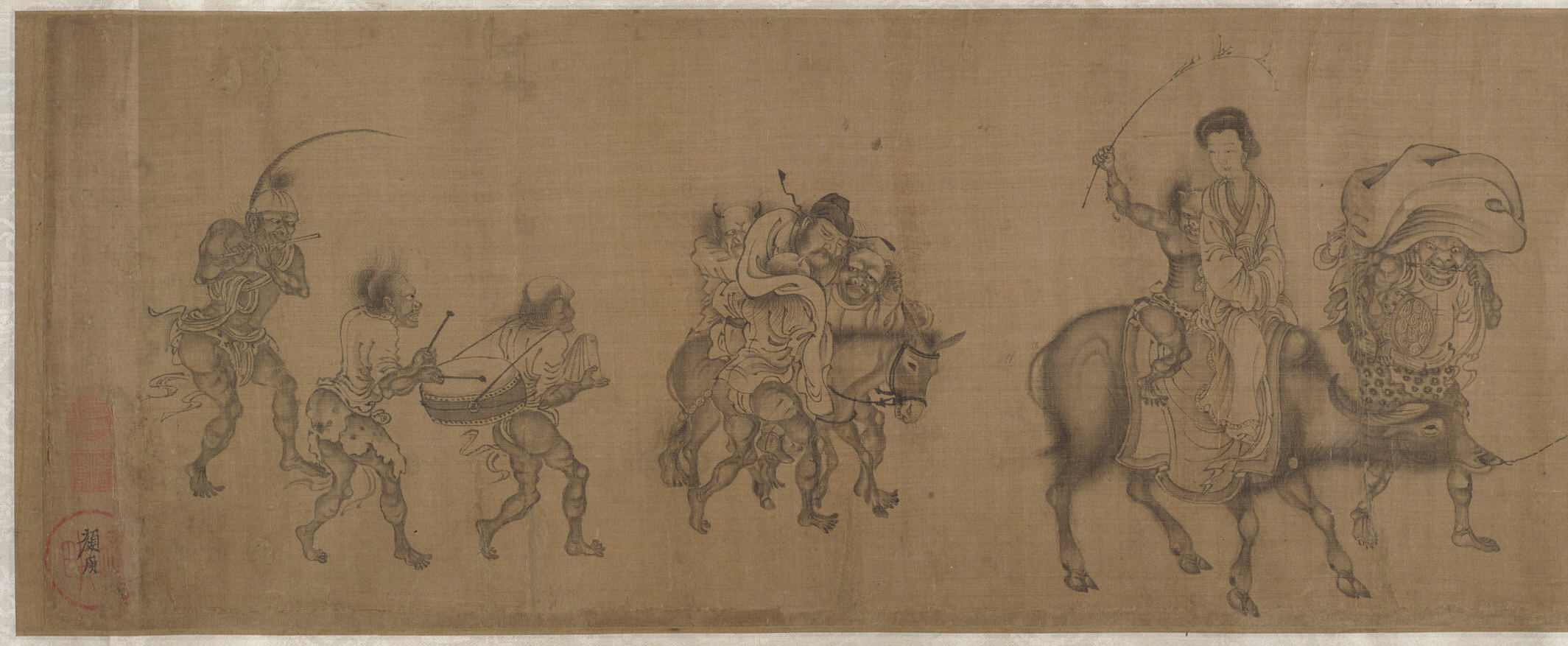

Onto the door: a Song print, a Ming merger
When did Zhong Kui move onto the door itself? Later than most retellings suggest. The Northern Song Dongjing Menghua Lu (《东京梦华录》, juan 10), a memoir of the capital, lists what the year-end market sold: "门神、钟馗、桃板、桃符" — door gods, Zhong Kui, peach boards and peach charms, as separate items. Its account of the New Year Nuo exorcism has performers dressed "as Zhong Kui, his little sister, the earth god, the kitchen god and the like" (CTP). In the Song, Zhong Kui stands next to the door gods; he is not one of them yet. The merger that put his face on the door leaf, replacing the older guardians Shenshu and Yulü, came gradually with the Ming-Qing novels. Reported
Into the registry: canonized from below
Does Zhong Kui have a seat in the Daoist pantheon? Sort of — but from below. The Yuan-Ming popular gods' registry Sanjiao Yuanliu Soushen Daquan (《三教源流搜神大全》) closes its third juan with a Zhong Kui entry. It retells the imperial dream, with one addition: the little ghost finally gets a name — Xuhao (虚耗, "Empty Waste"). Zhong Kui introduces himself there as "臣终南山进士钟馗" — "your servant, the jinshi graduate from Mount Zhongnan" (registry text). Note what that line is: a hometown-and-degree narrative, not a divine title.
The orthodox Daoist Canon has no Zhong Kui entry of its own. The grand titles — Demon-Quelling True Lord, Sage Who Bestows Blessings and Guards the Home, the Judge — accumulated through Ming-Qing novels and temple practice. A National Taiwan University study puts the trajectory in one sentence: Zhong Kui entered Daoism from the folk upward, not from the canon down (NTU). Reported
The five ghosts: the real story, and the viral list
Online you will find a confident-sounding list of Zhong Kui's "five ghost attendants": lantern-bearer, seal-bearer, umbrella-bearer, horse-leader, gourd-carrier. It circulates as folklore fact. We could not find it in any pre-modern text — it belongs to the stage, the New Year print, and oral tradition. Presenting it as classical would be exactly the kind of error this page exists to prevent.
The documented trail is better anyway. First, the nameless little ghost of the Tang dream gets a name, Xuhao, in the Yuan-Ming registry. Then a Yuan-Ming zaju play, Celebrating the Harvest Year: Five Ghosts Vex Zhong Kui (《庆丰年五鬼闹钟馗》), has five ghosts vexing him — and being subdued by him (play text). By the Qing stage play Tianxia Yue: The Sister's Marriage (《天下乐·嫁妹》), five ghosts attend the wedding procession as named roles: lantern ghost, carrying-pole ghost, umbrella ghost, donkey-driver ghost, big ghost (script). The "five ghosts bring wealth" (五鬼运财) variant is a modern conflation with the separate Wutong wealth-god cults. The pattern across all three is the same: Zhong Kui's ghosts are ghosts he subdued and put to work — which is, not incidentally, the mechanic at the center of the new game. Analysis
Why the game's choices rhyme with the layers
Look at what the demo and the official art actually show: a judge-figure on a tiger; a swordsman catching ghosts with written commands; a ghost society with kitchens, musicians and guides; a hero whose identity is deliberately withheld. Each of those choices has a layer to stand on — the club that became a name, the examinee ghost with a grievance, the painter's demon retinue, the stage's subdued five ghosts, the judge the folk tradition made. Game Science is not decorating with "Chinese mythology" as a flavor. It is choosing which century of Zhong Kui to put on screen, scene by scene. Analysis

Related: the legend itself, the creature research, the protagonist question, and the latest official updates.
A note to readers
Unless otherwise noted, translations from Chinese texts and the layer assessments are by ZhongKui News. If you cite this research: ZhongKui News, "A Thousand Years of Zhong Kui: From Exorcism Tool to Game Hero," September 2026. Corrections and research questions are welcome via our contact page.
Update log. Published September 2026; English text researched and edited in August 2026. "Shen Kuo never names the book" correction verified against the Bubit'an text; the five-ghost attendant list was checked against the pre-modern record and found absent. Open-access images only; the Freer scroll is described but not reproduced (Usage Conditions Apply).
Sources
Primary texts
- Kaogong ji with Zheng Xuan's commentary; Shuowen Jiezi Zhu — CTP. "Zhongkui means club."
- Gu Yanwu, Rizhi Lu, juan 32 ("Zhongkui") — Han Dian mirror; Zhao Yi, Gaiyu Congkao, juan 35 — CTP. The name hypothesis.
- Mengxi Bitan, Bubit'an juan 3 — CTP. The imperial dream; no book named.
- Dongjing Menghua Lu, juan 10 — CTP. Song year-end prints and the Nuo procession.
- Sanjiao Yuanliu Soushen Daquan, juan 3 — registry text. Xuhao and the Mount Zhongnan jinshi.
- Five Ghosts Vex Zhong Kui (Yuan-Ming zaju) — play text; Tianxia Yue: The Sister's Marriage — script.
Museum records and scholarship
- Zhongshan Going on Excursion, attr. Gong Kai — Freer Gallery, F1938.4 (Usage Conditions Apply); political-allegory debate: Liu, Ars Orientalis 2023.
- Zhong Kui Giving His Sister Away in Marriage, attr. Yan Geng — Metropolitan Museum, 1990.134 (Open Access).
- The Lantern Night Excursion of Zhong Kui, attr. Yan Hui — Cleveland Museum of Art, 1961.206 (CC0).
- "Zhong Kui entered Daoism from the folk" — National Taiwan University.
- Tang Zhongkui Quanzhuan entry — Encyclopedia of China. The later Tang Yishi attribution.


